Key takeaways
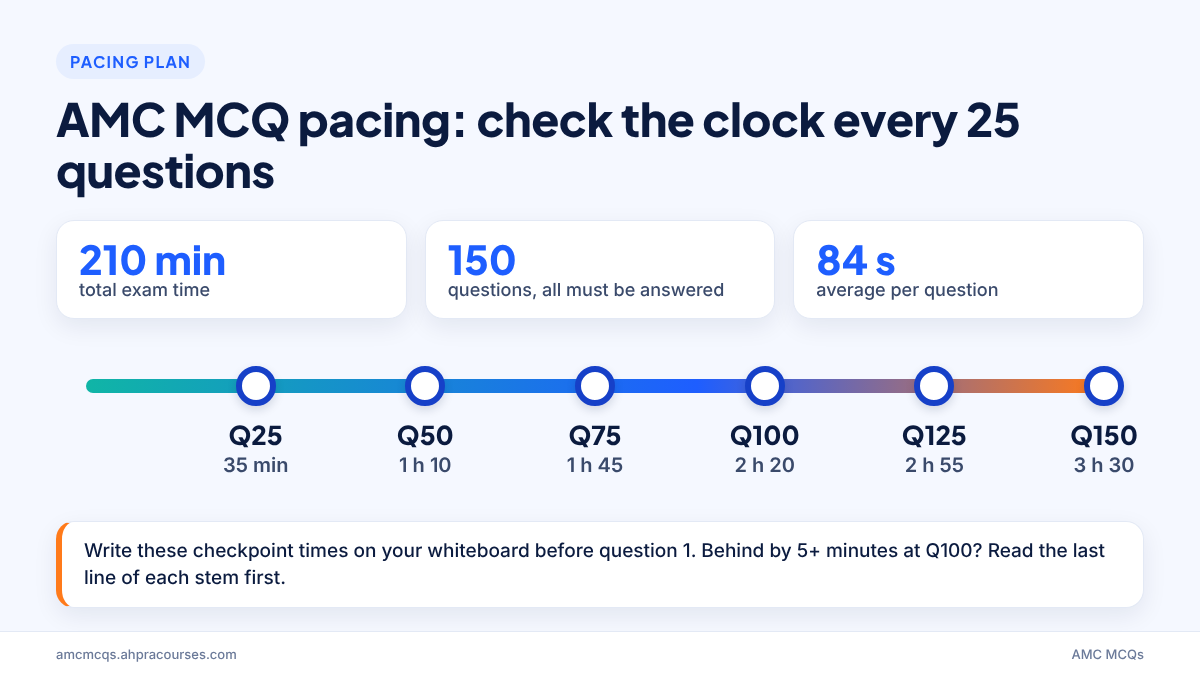
- Your pace is 84 seconds per question (210 minutes ÷ 150). Check the clock at every 25th question: question 50 by 70 minutes, question 100 by 140 minutes.
- You must answer each question before the next appears and you cannot go back, so commit, move on and never carry a question in your head.
- Marks are not deducted for wrong answers. Never let time run out with questions unseen: an incomplete exam can be recorded as "Fail – insufficient data to obtain result".
- The pass mark is 250 on a 0–500 scale, and 250 is not 50% correct. Judging difficulty mid-exam tells you nothing useful.
- Most first-attempt failures come from non-Australian answers, weak time control, neglected small domains and untimed practice, not from a lack of medical knowledge.
If you want to pass the AMC MCQ first attempt, knowledge alone is not enough. The AMC Computer Adaptive Test (CAT) MCQ Examination gives you 150 single-best-answer questions in one 3.5-hour session, delivers them one at a time, and never lets you go back. That format punishes slow reading, second-guessing and gaps in Australian practice far more than it punishes a missing fact.
This guide gives you 17 specific tactics that working international medical graduates (IMGs) can apply from today: pacing at 84 seconds per question, a forward-only answering routine, how to guess well, an error log that actually changes your score, how to read your mocks, a day-by-day plan for the final two weeks, and an exam-day routine. It finishes with the most common reasons capable doctors fail, so you can avoid them.
Why it pays to pass the AMC MCQ first attempt
A first-attempt pass is worth planning for because every attempt costs time and money. At the time of writing (October 2026) the CAT MCQ authorisation fee is A$2,920, on top of the A$642 portfolio establishment fee you paid at the start. Confirm current fees on the AMC website before you budget.
Time matters too. Results are released at 4.00pm (AEST/AEDT) on the Friday three weeks after your exam, and you cannot apply for another exam until your scheduled result arrives. A fail costs a new fee, a new authorisation and usually months. Our AMC MCQ fees, booking and dates guide explains the authorisation and rescheduling rules in full.
What a pass actually requires
The AMC reports your result on a scale of 0 to 500, and the pass mark is 250. That is a single pass point for every candidate, regardless of cohort or which questions you received. A score of 250 is not the same as answering 50% correctly, because the adaptive test weights your responses by the difficulty of the calibrated questions you answered. The AMC has advised candidates of an update to the pass standard for 2026 sittings; the reported pass mark is still 250, so check the current specifications. Our AMC MCQ pass mark and scoring explainer walks through how the scale works.
You do not need perfection. You need consistent, safe, Australian-standard decisions across all six domains at a steady pace.
Exam-format tactics to pass the AMC MCQ first attempt
The first six tactics are about the test itself; they protect marks you have already earned.
Tactic 1: Own the 84-second pace
3.5 hours is 210 minutes. Divided by 150 questions, that gives you 84 seconds each. Some questions (a straightforward vaccine schedule item) take 40 seconds; others (a long stem with a table of results) take two minutes. The average is what matters.
The exam platform shows a timer clock. Instead of checking it after every question, which wastes attention, use fixed checkpoints every 25 questions.
| After question | Time used (84 s pace) | Time remaining | If you are behind |
|---|---|---|---|
| 25 | 35 min | 2 h 55 min | Normal to be 2–3 minutes slow while settling in |
| 50 | 1 h 10 min | 2 h 20 min | Cap any question at 2 minutes from here |
| 75 | 1 h 45 min | 1 h 45 min | Halfway: time and questions should match |
| 100 | 2 h 20 min | 1 h 10 min | More than 5 minutes behind: read the last line first on every stem |
| 125 | 2 h 55 min | 35 min | Under 30 minutes left: about 70 seconds per question |
| 150 | 3 h 30 min | 0 | Every question answered |
Write the checkpoint times on the whiteboard provided before you start question 1, so you compare two numbers instead of doing arithmetic under pressure.
Tactic 2: Use a forward-only answering routine
The AMC specifications state that each question must be answered before the next is delivered, and that once a question has been answered you cannot go back and change your response. There is no flag-and-review button. Many IMGs have spent years in paper exams where returning to doubtful questions was a core strategy; that habit has to go.
Use the same four-step routine on every item:
- Read the last line first. "Most appropriate next step", "most likely diagnosis" and "most appropriate initial investigation" are different tasks.
- Read the stem once, actively. Note age, sex, setting (GP, rural emergency department, ward), vital signs and the one or two findings that change management.
- Predict the answer before looking at the options. If your prediction is listed, check the others quickly and commit.
- Eliminate, choose, move on. Once you click, the question is finished. Do not carry it with you.
Tactic 3: Never leave the exam incomplete
You must complete all 150 items. The specifications warn that failing to do so may leave too little information for a reliable score, and the result may be recorded as "Fail – insufficient data to obtain result". Running out of time is one of the few ways to fail an exam you were on track to pass.
If you reach 15 minutes remaining with more than 12 questions left, switch to rapid mode: last line, key finding, best option, next. A quick educated answer is far better than an unseen question.
Tactic 4: Guess intelligently, because you have to
Marks are not deducted for incorrect answers, and the platform will not let you skip, so on every hard question you will make a choice anyway. Make it an informed one:
- Eliminate options that are unsafe, outdated or not available first-line in Australian general practice.
- Prefer the option that addresses the immediate threat (airway, breathing, circulation, sepsis, suicide risk, child safety) when the stem signals urgency.
- Prefer the least invasive appropriate step when the patient is stable: history detail, examination, bedside test, then imaging, then procedure.
- If two options are near-identical, the answer is often one of them; the difference between them is usually the teaching point.
Tactic 5: Ignore how hard the questions feel
In the CAT, the first question is chosen at random; a correct answer leads to a harder question and an incorrect answer to an easier one, and your ability estimate is recalculated after each response. That means a strong candidate will feel the exam getting harder. Feeling stretched is often a sign you are doing well, not badly.
There is a second reason to ignore difficulty. At least half of the questions come from a pool of previously calibrated items, and the rest are new questions being calibrated before they are used for scoring. Some items do not count, and you cannot tell which. The bizarre question that throws you may be one of them. Give it your best 84 seconds and leave it behind.
Tactic 6: Reset in 10 seconds after a bad question
Because you cannot return, a question you know you got wrong can follow you for the next five. Practise a reset ritual in every timed block: one slow breath out, shoulders down, eyes on the next stem's last line.
Exam tip: Practise under the real rules from the start of your preparation, not just in the final month. Our timed blocks run at 84 seconds per question, and the full 150-question mock uses a 3.5-hour countdown with forward-only navigation, so the exam format feels routine by the time you sit it.
Sit a timed AMC MCQ mock exam
Blueprint-weighted questions under exam timing, then a breakdown of your result by domain.
How to read AMC questions like an Australian clinician
The AMC tests the disease process, clinical examination and diagnosis, investigation, and therapy and management. Questions are also built around three clinician tasks: data gathering, data interpretation and synthesis, and management. Recognising which task a stem is testing narrows your options quickly.
Tactic 7: Identify the clinician task in every stem
| Clinician task | Typical last line | What the best answer usually looks like |
|---|---|---|
| Data gathering | "What is the most important question to ask?" / "Which examination finding would be most helpful?" | The item that separates the two most likely diagnoses or reveals a red flag |
| Data interpretation and synthesis | "What is the most likely diagnosis?" / "What does this result indicate?" | The diagnosis that explains every finding, including the odd one |
| Management | "What is the most appropriate next step?" / "What is the most appropriate initial treatment?" | The safest correct action at this moment, in this setting, under Australian guidance |
Tactic 8: Answer for the setting in the stem
"Next step" depends on where the patient is. The same chest pain is managed differently in a metropolitan emergency department, a remote clinic and a GP surgery. Read for clues such as "rural hospital", "general practice", "nursing home" or "telehealth", and choose the action that is realistic there.
Setting also means country. The AMC expects Australian practice: Therapeutic Guidelines (eTG) antibiotic choices, the National Immunisation Program schedule, national screening programs and Australian law on consent and confidentiality. Our guide to Australian guidelines for the AMC MCQ sets out where these differ from what many IMGs learned at home.
Tactic 9: Treat "most appropriate" as "safest correct now"
Several options in an AMC question are often defensible. The best answer is the one that is correct for this patient now, not the eventual definitive treatment. A stable patient with suspected ectopic pregnancy needs confirmation before surgery; an unstable one needs resuscitation and theatre. Ask yourself, "What would a safe intern-level doctor in Australia do first?"
A 31-year-old woman presents to a general practice with 10 minutes of generalised urticaria, lip swelling, wheeze and light-headedness after a bee sting in her garden. Her blood pressure is 84/50 mmHg and pulse 124/min. What is the most appropriate immediate management?
- Intravenous hydrocortisone 200 mg given as a slow bolus
- Intramuscular adrenaline 0.5 mg into the lateral thigh
- Nebulised salbutamol 5 mg via a face mask
- Oral promethazine 25 mg and observation for one full hour
- Intravenous adrenaline 1 mg as a rapid push
Show answer and explanation
Answer: B. This is anaphylaxis with hypotension and bronchospasm. Intramuscular adrenaline (0.01 mg/kg, maximum 0.5 mg in adults, using 1 mg/mL adrenaline) into the anterolateral thigh is the first and most important treatment, followed by lying her flat, calling for help and giving oxygen and fluids. A is wrong because corticosteroids act too slowly and do not treat the acute reaction. C treats wheeze only and delays adrenaline. D is unsafe because antihistamines do not reverse airway oedema or shock. E is wrong because a 1 mg intravenous bolus is a cardiac arrest dose and risks arrhythmia in a patient with a pulse. The tactic: when the stem signals an immediate threat, the answer is the action that removes it.
Preparation tactics that raise your score
These tactics turn study hours into marks.
Tactic 10: Study to the blueprint, not your comfort zone
The AMC blueprint allocates questions by patient group. In a 150-question exam the approximate numbers are:
| Domain | Weight | About how many questions |
|---|---|---|
| Adult health – Medicine | 30% | about 45 |
| Adult health – Surgery | 20% | about 30 |
| Women's health (obstetrics and gynaecology) | 12.5% | about 19 |
| Child health | 12.5% | about 19 |
| Mental health | 12.5% | about 19 |
| Population health and ethics | 12.5% | about 19 |
The four smaller domains together make up half the exam. An internal medicine specialist who neglects obstetrics, paediatrics, psychiatry and ethics is putting about 75 questions at risk. Allocate study time roughly in proportion to these weights, then add extra time to whichever domain your analytics show is weakest. Our AMC MCQ study plan converts these weights into weekly hours for working doctors.
Tactic 11: Keep an error log that classifies every mistake
Doing thousands of questions without reviewing them properly is the most common wasted effort in AMC preparation. For every question you get wrong, or get right by guessing, record one line:
| Error type | What it looks like | The fix |
|---|---|---|
| Knowledge gap | You had never learned the fact or threshold | Learn it from an Australian source; make one flashcard |
| Non-Australian answer | Right at home, wrong here (drug, schedule, screening age) | Add to a dedicated "Australian differences" page and re-read weekly |
| Misread stem | Missed "pregnant", "child", "next step", "most likely" | Re-run the four-step routine; underline the last line on the whiteboard |
| Sequencing error | Chose the definitive step instead of the next step | Ask "safest correct now?" before every management answer |
| Changed from correct | Your first choice was right, then you switched | Only change a prediction when you find a specific fact in the stem |
| Time pressure | Rushed because you were behind | Practise checkpoints in every timed block |
After 300 to 500 questions, count the categories. If a third of your errors are "non-Australian answer", targeted Australian revision will help more than textbooks.
Tactic 12: Read every explanation, including for questions you got right
A correct answer reached for the wrong reason is a future wrong answer. Read why each distractor is wrong; one well-explained question can teach you five facts.
Tactic 13: Move from tutor mode to timed blocks
A sensible progression: untimed tutor mode by domain in the first third of your preparation, 25 to 50-question timed mixed blocks in the middle third, and full 150-question mocks in the final third.
Tactic 14: Analyse mocks properly
A mock exam is a diagnostic test, not a ritual. Sit at least two full 150-question mocks under real conditions: the same time of day as your booking, 3.5 hours, no phone, forward-only navigation. Then spend at least as long reviewing it as you spent sitting it.
- Timing: where were you at questions 50, 100 and 125? Did you speed up or slow down late?
- Domain breakdown: which domain was weakest? Is it the same one as last time?
- Error mix: how many were knowledge gaps versus misreads versus non-Australian answers?
- Fatigue: compare your accuracy in questions 1–75 with 76–150. A big drop means you need more full-length practice, not more content.
Judge readiness from a trend across mocks and timed blocks and stable performance in all six domains, not from one score.
Try AMC MCQ practice questions free
Create a free account and answer sample questions with full explanations before you buy a pass.
Tactic 15: Use spaced revision cycles
Facts learned in month one fade by month four unless revisited. Redo incorrect questions after one week and again after a month, re-read your "Australian differences" page weekly, and bookmark questions with numbers you keep forgetting.
The last two weeks before the AMC MCQ
The final fortnight is for consolidation, not new textbooks.
Tactic 16: Follow a structured final fortnight
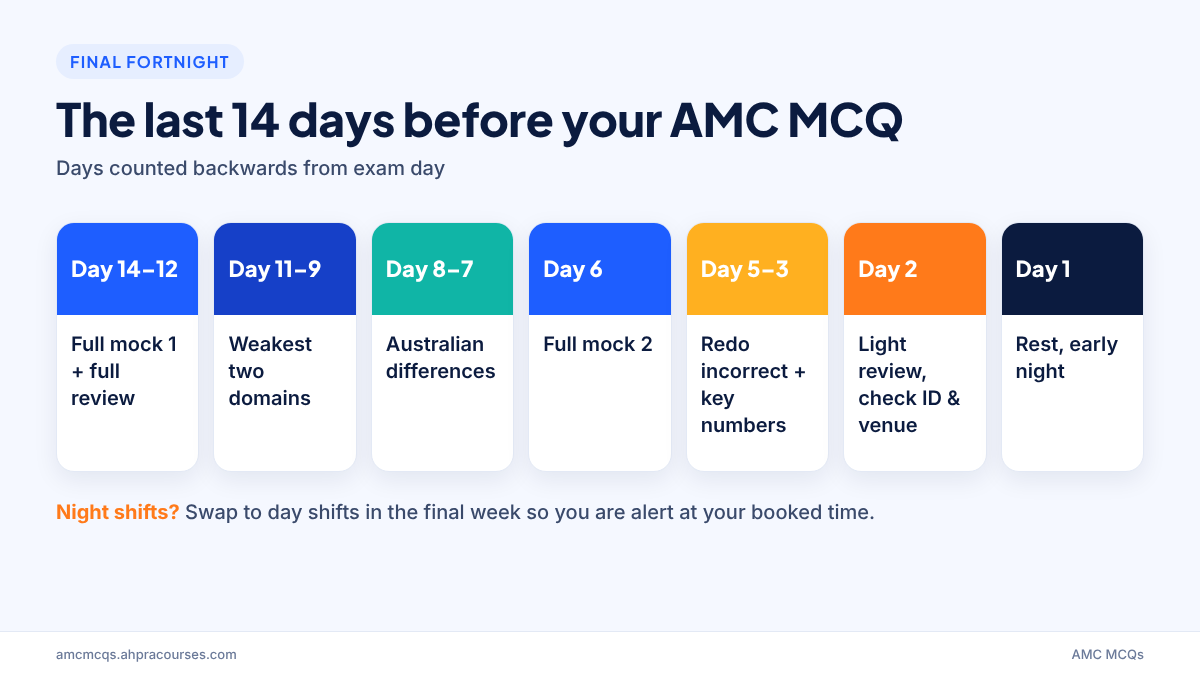
| Days before exam | Focus | Daily target |
|---|---|---|
| 14–12 | Full mock 1 under real conditions, then a complete review | Mock day, then 2 review days |
| 11–9 | Weakest two domains from the mock | 60–80 timed questions plus error-log review |
| 8–7 | Australian differences: screening, immunisation, eTG, law and ethics | 40 timed questions plus your differences page |
| 6 | Full mock 2 (or a second set of 150 mixed questions) | Mock and timing review |
| 5–3 | Redo incorrect questions; high-yield numbers; light mixed blocks | 50 questions, focus on accuracy |
| 2 | Light review only; confirm venue, travel and ID | 20–30 questions maximum |
| 1 | Rest; no new content; early night | None |
If you work night shifts, try to swap your final week to days. You want your body clock to be alert at the time of your booking, not at 3am.
What to review in the final week
Prioritise your error log ("non-Australian answer" entries first), screening ages, the immunisation schedule, eTG first-line antibiotics, emergency algorithms (anaphylaxis, sepsis, acute asthma, diabetic ketoacidosis, postpartum haemorrhage), consent and confidentiality rules, and biostatistics formulas.
Your AMC MCQ exam-day routine
A calm exam morning is built the week before: check your Pearson VUE confirmation, the venue and the real journey time.
Tactic 17: Run a rehearsed exam-day routine
- Arrive at least 30 minutes early. The AMC requires it, and check-in includes a biometrics step (ID check, signature capture and photo).
- Bring the right identification. The AMC events page asks for two forms of ID, both signed, with the primary ID carrying your photo (for example, a passport). ID must be in English or come with a certified English translation. Without it you can be refused entry.
- Expect an empty desk. A whiteboard and pen are provided; you cannot take paper, pens, phones, bags, food or drink into the exam room. Eat a proper meal beforehand.
- Set up your whiteboard. Write the checkpoint times (35, 70, 105, 140 and 175 minutes) before question 1.
- Settle in over the first 10 questions. Being a minute or two behind at question 25 is normal.
- Report problems straight away. If there is a technical or environmental issue, raise your hand for the invigilator rather than struggling on.
Exam tip: Read the latest AMC CAT MCQ Examination Specifications and the exam events page in the week of your exam. Rules on identification and conduct are set by the AMC and Pearson VUE, and the current documents always override any guide, including this one.
Mindset on the day
Expect to feel uncertain often; an adaptive test keeps searching for the edge of your ability. You can get many questions wrong and still pass, but you cannot let one bad question wreck the next ten.
A 29-year-old woman presents to an emergency department with 7 weeks of amenorrhoea and mild left iliac fossa pain. She has had light vaginal spotting since yesterday. Her pulse is 82/min, blood pressure 118/76 mmHg, and her abdomen is soft with mild left-sided tenderness. A urine pregnancy test is positive. What is the most appropriate next step?
- Urgent diagnostic laparoscopy in the operating theatre
- Repeat urine pregnancy test in 48 hours, then review
- Transvaginal ultrasound and quantitative serum hCG
- Intramuscular methotrexate given as a single dose today
- CT of the abdomen and pelvis with intravenous contrast
Show answer and explanation
Answer: C. She is haemodynamically stable with a possible ectopic pregnancy, so the next step is to locate the pregnancy: transvaginal ultrasound together with a quantitative serum hCG (and blood group, so anti-D can be considered if she is RhD negative). A would be right only if she were unstable or had signs of significant intraperitoneal bleeding. B delays diagnosis in a potentially life-threatening condition and a qualitative urine test adds nothing. D is premature because methotrexate is given only once an ectopic pregnancy is diagnosed and criteria are met. E exposes a possible pregnancy to radiation and is not the right test. The tactic: for a stable patient, "next step" is usually the investigation that confirms the diagnosis, not the definitive treatment.
Common reasons IMGs fail the AMC MCQ first time
Most doctors who fail the AMC MCQ are competent clinicians. They usually fail for predictable, fixable reasons:
- Answering for another country. Choosing the drug, screening age or legal rule from their home system or from UK or US resources. Australian guidance decides the answer.
- Neglecting the smaller domains. Women's health, child health, mental health and population health and ethics are about 75 questions combined. Weakness in two of them can sink an otherwise strong paper.
- Doing questions without reviewing them. High question counts with no error log repeat the same mistakes.
- Practising untimed until the end. Discovering on the day that 84 seconds feels short is too late.
- Relying on recall collections. Memorised "recalls" of uncertain accuracy encourage pattern-matching rather than reasoning, and an adaptive test draws on a large, changing pool. Learn the reasoning instead.
- Too few full-length mocks. Concentration and accuracy often fall after question 100. Only full mocks train that stamina.
- Weak ethics and law. Consent, capacity, confidentiality and mandatory reporting follow Australian law and the Medical Board of Australia's code of conduct, which may differ from what you practised before.
- Booking before you are ready, or long after. Book once your timed performance is stable across all domains, then protect your study time in the final six weeks.
- Exhaustion. Studying after night shifts without rest days leads to slow reading and poor recall. Planned rest is part of the plan.
Choose a pass for AMC MCQ
Basic, Pro and Premium passes for 1, 3 or 6 months. One exam per pass, from $30, no auto-renewal.
How to use a question bank to pass first time
A question bank is the closest thing to the real exam you can practise daily. Used well, it shows what you do not know, trains your pace and builds Australian reflexes.
- Cover all six domains in proportion. Our 3,000 original questions are blueprint-weighted, and analytics show your accuracy by domain and subtopic.
- Drill weak areas, then mix. Use weak-area drills and redo-incorrect sessions, then return to mixed timed blocks, because the real exam is mixed.
- Finish with full mocks that mirror the real 3.5-hour, forward-only format.
If you are still choosing materials, our AMC MCQ preparation resources guide compares official AMC resources, Australian guidelines and question banks for different budgets. For the conditions most worth mastering in each domain, see our AMC MCQ high-yield topics. You can compare the one-time question packs on our pricing page.
Our questions are original and written to the AMC blueprint; they are not recalls, and this site is not affiliated with the AMC.
Frequently asked questions
Is it realistic to pass the AMC MCQ on the first attempt?
Yes. Many IMGs pass first time, including doctors studying while working full time. The candidates who do usually study to the AMC blueprint, practise under timed, forward-only conditions, learn Australian guidelines rather than home-country practice, and review every mistake with an error log.
How many seconds do I have per AMC MCQ question?
On average 84 seconds: the exam gives 3.5 hours (210 minutes) for 150 questions. Use checkpoints every 25 questions, aiming to finish question 50 by 70 minutes and question 100 by 140 minutes, rather than checking the clock after every item.
Can I skip questions or go back in the AMC CAT MCQ?
No. You must answer each question before the next is delivered, and once you answer you cannot go back to change it. That is why a forward-only routine of reading the last line first, predicting, eliminating and committing is essential.
Should I guess on the AMC MCQ?
Yes. The AMC states that marks are not deducted for incorrect answers, and you cannot move on without answering. Eliminate unsafe or non-Australian options first and choose the safest correct action for the setting in the stem.
What happens if I do not finish all 150 questions?
The AMC expects candidates to complete all 150 items. If you do not, there may not be enough information to produce a reliable score, and the result may be recorded as "Fail – insufficient data to obtain result". Keep to your pace so this never happens.
How many practice questions should I do before the AMC MCQ?
There is no official number. Quality of review matters more than volume, but most well-prepared candidates complete a few thousand exam-style questions across all six domains, plus at least two full 150-question timed mocks, and review every incorrect answer.
Does the AMC MCQ getting harder mean I am failing?
Usually the opposite. The test is adaptive: a correct answer leads to a harder question and an incorrect one to an easier question. Some items are also new and unscored. Do not try to judge your performance from difficulty during the exam.