Key takeaways
- The AMC CAT MCQ Examination has 150 single-best-answer questions (five options each) in one 3.5-hour session, which works out to 84 seconds per question.
- It is adaptive: a correct answer brings a harder question, an incorrect one an easier question. You cannot skip or go back.
- Results are reported on a 0–500 scale and the pass mark is 250. A score of 250 does not mean 50% correct.
- The blueprint is fixed: Medicine 30%, Surgery 20%, and 12.5% each for women's health, child health, mental health, and population health and ethics.
- At the time of writing (October 2026) the MCQ authorisation costs A$2,920 and initial portfolio establishment costs A$642. Confirm current fees on amc.org.au.
- Results are released in your AMC account at 4.00pm on the Friday three weeks after your exam.
If you are studying between night shifts, you want straight answers: what the exam looks like, what it costs, how to book it, how it is marked and how to prepare. This guide covers all of that using the AMC's own published rules.
What is the AMC MCQ exam?
The official name is the AMC Computer Adaptive Test (CAT) MCQ Examination. It is a computer-administered, fully integrated multiple-choice exam that tests your medical knowledge and clinical reasoning across the whole of general medical practice, not one specialty at a time.
The AMC sets and scores the exam; Pearson VUE runs the test centres. You book your seat with Pearson VUE but receive your result from the AMC.
According to the AMC, the exam covers the disease process, clinical examination and diagnosis, and investigation, therapy and management. In practice that means a question can ask you to pick the most likely diagnosis, the next best investigation, the first-line treatment or the most appropriate advice, all set in an Australian clinical context.
Where the MCQ sits in the Standard pathway
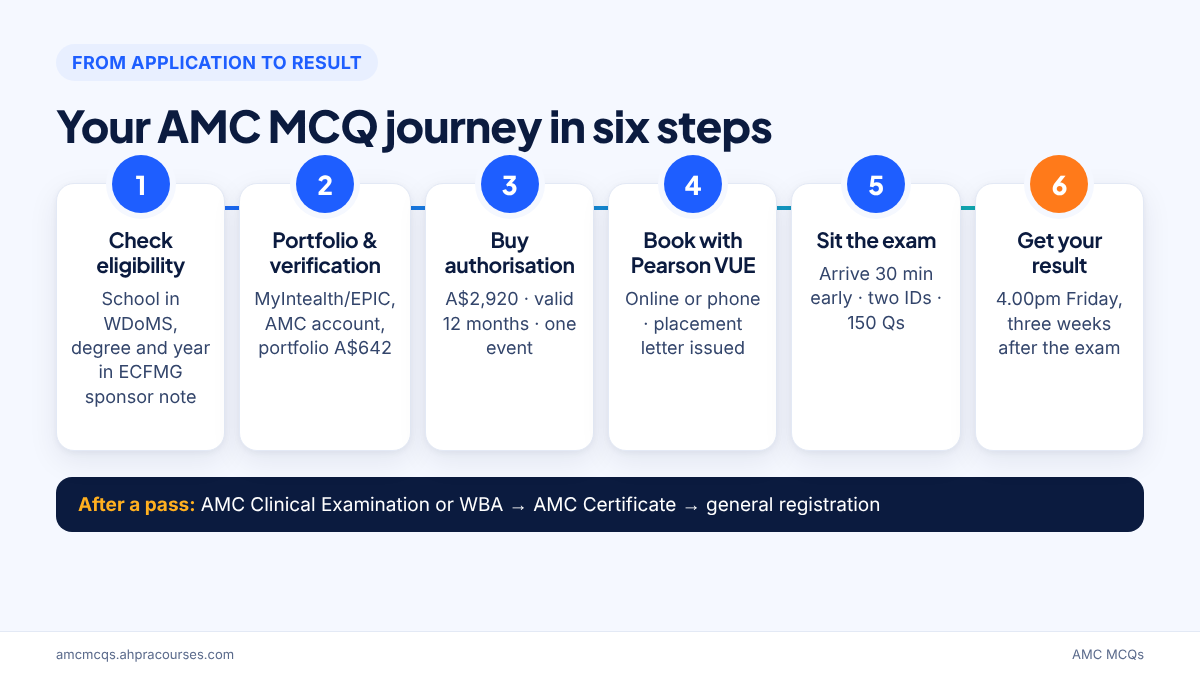
The MCQ is the compulsory first assessment on the AMC Standard pathway. Next comes either the AMC Clinical Examination or a workplace-based assessment (WBA) program; passing both earns the AMC Certificate, which supports general registration with the Medical Board of Australia through Ahpra.
Who needs to sit the AMC MCQ exam?
The Standard pathway is designed for international medical graduates who want general registration in Australia, hold an eligible primary medical degree, and are not eligible for the Competent Authority pathway.
You are generally not on the Standard pathway if you have already been assessed by one of the competent authorities the Medical Board recognises and meet its experience criteria. These are the General Medical Council (UK), Medical Council of Canada, ECFMG (USA), Medical Council of New Zealand, Medical Council of Ireland and the National Board of Osteopathic Medical Examiners (USA). Overseas-trained specialists seeking specialist registration usually follow the Specialist pathway through the relevant college instead.
Eligibility of your medical degree
Before you spend anything, check that your degree is eligible. The AMC requires that:
- your medical school is listed in the World Directory of Medical Schools and meets the ECFMG Sponsor Note requirements;
- your degree is your final, primary qualification in clinical medicine and surgery, with its title included in the sponsor note;
- your graduation year appears under "Graduation Years" in that sponsor note.
The Medical Board also notes that you need a completed internship or comparable training. Without one, you must secure an accredited internship position in Australia, which can be difficult, so factor this in before committing to the pathway.
Exam tip: Candidates whose primary residency is in a country sanctioned by the US Treasury (OFAC) may not be able to sit. From 8 September 2026, Pearson VUE cannot test Iranian residents without proof of primary residency elsewhere. Check the AMC MCQ page before you pay.
AMC MCQ exam format at a glance
Everything below comes from the AMC CAT MCQ Examination Specifications (version 8, September 2025). Read the full document once; it is free and short.
| Feature | What the AMC specifies |
|---|---|
| Number of questions | 150 multiple-choice questions; you must answer all of them |
| Time | One 3.5-hour session with an on-screen timer (about 84 seconds per question) |
| Question type | Single best answer: a stem followed by five options (A–E) |
| Images and data | Some items include X-rays, ECGs, scans or clinical photographs, still with five options |
| Delivery | Computer-based at Pearson VUE test centres in Australia and overseas |
| Adaptivity | Correct answer leads to a harder question; incorrect answer to an easier one |
| Navigation | No skipping and no returning to earlier questions |
| Negative marking | None: marks are not deducted for incorrect answers |
| Scoring | Scaled score from 0 to 500; pass mark 250 |
Single best answer, five options
Each item gives a clinical vignette or data set and asks one focused question. Several options may be partly correct; pick the best answer for an Australian doctor in that setting. Details such as age, pregnancy, rural location or a vital sign often change the priority.
How the computer adaptive format works
The first question is chosen at random from the item pool. After every response the software recalculates its estimate of your ability, then serves a question targeted to that estimate. Answer correctly and the next question is harder; answer incorrectly and it is easier. This is why two candidates sitting on the same day can see very different papers and still be compared fairly: each exam is equated to the others drawn from the AMC pools.
A practical consequence: the exam feels hard when you are doing well. Rising difficulty is the algorithm doing its job, not a sign of failure.
No skipping and no going back
You must answer each question before the next appears and cannot return to change a response. There is no "flag for review", so you need a decision routine that works in under 90 seconds. Our guide to passing the AMC MCQ on your first attempt covers pacing and guessing tactics in detail.
Questions that do not count
At least half of the questions come from a pool of previously calibrated items. The rest are new questions that the AMC inspects and calibrates before they contribute to scoring. You will not know which ones are which, so treat every question as if it counts.
The AMC MCQ blueprint: what is examined
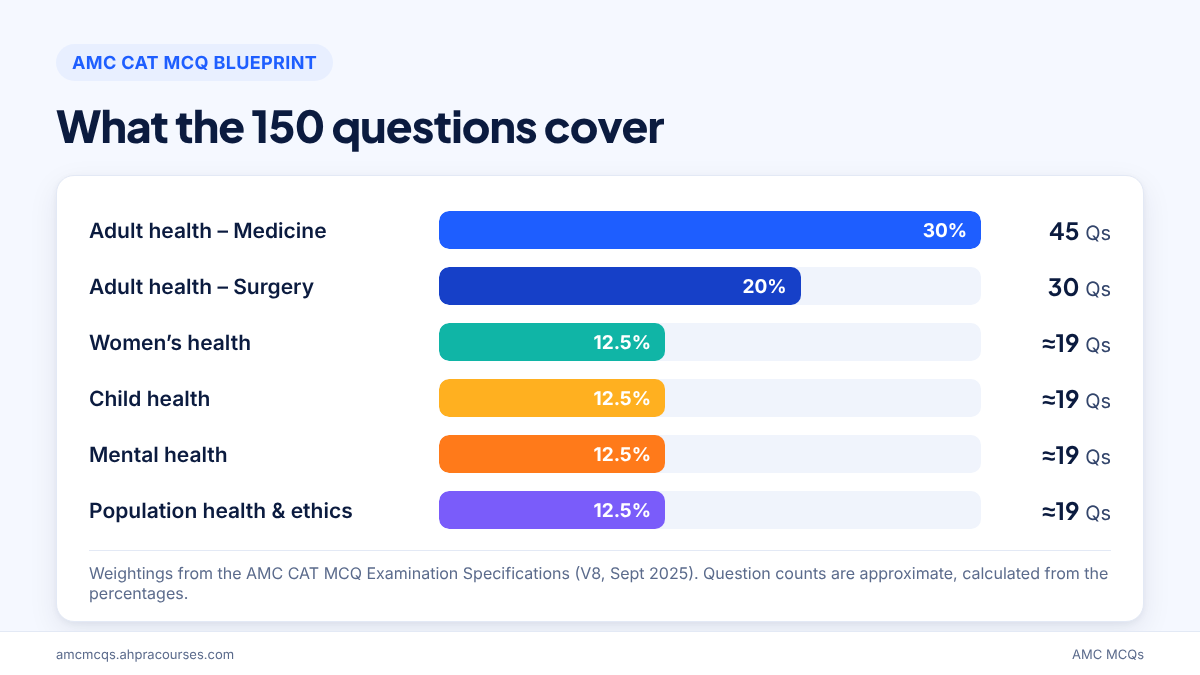
The AMC blueprints the exam by patient group. The weighting is fixed, which makes it the single most useful planning tool you have. The approximate item counts and time below are calculated from the published percentages and the 84-second pace.
| Patient group | Weighting | About how many of 150 questions | About how much exam time |
|---|---|---|---|
| Adult health – Medicine | 30% | 45 | 63 minutes |
| Adult health – Surgery | 20% | 30 | 42 minutes |
| Women's health (obstetrics and gynaecology) | 12.5% | about 19 | about 26 minutes |
| Child health | 12.5% | about 19 | about 26 minutes |
| Mental health | 12.5% | about 19 | about 26 minutes |
| Population health and ethics | 12.5% | about 19 | about 26 minutes |
Medicine and surgery make up half the exam, but the four 12.5% groups make up the other half, and that is where many IMGs lose marks: Australian obstetric care, immunisation, mental health law and screening differ from practice at home.
The three clinician tasks
Across every patient group, questions test three unweighted clinician tasks:
- Data gathering: history, mental state and physical examination, and investigations.
- Data interpretation and synthesis: interpreting results, prioritising problems, risk stratification and diagnosis.
- Management: education, counselling, drug and non-drug therapy, procedures, complications, rehabilitation, palliative and community care.
What "Australian context" means for you
The exam assumes you will work as a junior doctor in Australia, so you must know how Australian guidelines handle common problems, for example:
- national screening programs, such as cervical screening every five years for people with a cervix aged 25 to 74 when results are normal;
- the National Immunisation Program schedule and the Australian Immunisation Handbook;
- antibiotic choices from Therapeutic Guidelines rather than another country's formulary;
- the NHMRC alcohol guideline of no more than 10 standard drinks a week and no more than 4 on any one day for healthy adults;
- consent, confidentiality, mandatory reporting and the Medical Board's code of conduct;
- Aboriginal and Torres Strait Islander health, and practice in rural and remote settings.
We have a dedicated guide to the Australian guidelines tested in the AMC MCQ that sets out where local practice differs from India, Pakistan, the UK and the US.
Try AMC MCQ practice questions free
Create a free account and answer sample questions with full explanations before you buy a pass.
Two worked AMC-style questions
These are original questions written in the AMC format to show the style and the level of Australian detail expected. They are not recalls.
A 48-year-old man attends his GP for a health check. He is otherwise well and takes no regular medicines. He drinks two standard drinks each weeknight and five standard drinks on Saturday, and none on Sunday. He asks whether his drinking is within the Australian guidelines. Which advice is most appropriate?
- His intake is within guidelines because it averages under three a day
- He should keep below 14 standard drinks a week with two alcohol-free days
- He should drink no more than 10 a week and no more than 4 on any day
- He only needs to reduce his Saturday intake to fewer than six drinks
- He should stop completely, as any alcohol exceeds the national advice
Show answer and explanation
Answer: C. The NHMRC Australian Guidelines to Reduce Health Risks from Drinking Alcohol advise healthy adults to drink no more than 10 standard drinks a week and no more than 4 standard drinks on any one day. He drinks 15 a week and 5 on Saturday, so he exceeds both limits. A is wrong because the guideline sets weekly and single-day limits, not a daily average. B uses a UK-style weekly limit and is not the Australian advice. D would still leave him above the weekly limit and above the four-drink single-day limit. E is wrong because abstinence is advised for under-18s and in pregnancy, not as a blanket rule for healthy adults.
A 27-year-old woman who moved to Australia two years ago asks when she next needs cervical screening. At age 25 she had a Cervical Screening Test in Sydney, and the result was reported as oncogenic HPV not detected. She has no symptoms and is not pregnant. When is her next routine screening test due?
- Now, as the routine interval is every two years
- At age 30, five years after the previous test
- Next year, three years after the previous test
- Not until age 35, as her first result was normal
- Only if symptoms such as bleeding develop later
Show answer and explanation
Answer: B. Under the National Cervical Screening Program, people with a cervix aged 25 to 74 who have ever been sexually active are screened with an HPV-based Cervical Screening Test every five years when results are normal. Her test at 25 showed no oncogenic HPV, so she is next due at 30. A reflects the old two-yearly Pap smear program, which the HPV-based test replaced. C is an interval used in some other countries' cytology programs. D wrongly extends the interval. E confuses screening of asymptomatic people with investigation of symptoms; symptomatic patients need diagnostic assessment, not a screening test.
How the AMC MCQ exam is scored
Your result is a scaled score between 0 and 500. The pass mark is 250, and it is a single cut score for the whole exam, regardless of the cohort you sat with or which questions you received.
The score measures your ability, not your raw number of correct answers. Because the test is adaptive, a candidate who answers harder questions correctly can score higher than someone with the same number of correct answers on easier questions. That is why a 250 is not the same as 50% correct, and why no one can honestly tell you a "percentage needed to pass".
Two more scoring rules matter on the day:
- Answer everything. Marks are not deducted for incorrect answers, so a reasoned guess always beats a blank.
- Finish all 150. If you do not complete the exam, there may not be enough information for a reliable ability estimate, and the result may be recorded as "Fail – insufficient data to obtain result".
The AMC has advised candidates of an update to the pass standard for 2026 sittings; the reported pass mark is still 250. Check the current specifications before you sit. For a full explanation of scaled scores, adaptivity and how to read your transcript, see our guide to the AMC MCQ pass mark and scoring.
AMC MCQ exam fees
These are the AMC's listed fees at the time of writing (October 2026), in Australian dollars. Confirm on the AMC fees page before you pay.
| Item | Fee (A$) | Notes |
|---|---|---|
| Portfolio establishment (initial portfolio) | 642 | Includes one qualification; each additional qualification is A$107 |
| CAT MCQ examination authorisation | 2,920 | Valid for 12 months; one exam event |
| Reissue of MCQ results | 107 | Only if you need results reissued |
| AMC Clinical Examination (in person) | 3,000 | After you pass the MCQ |
| AMC Clinical Examination (online) | 3,400 | Includes a A$400 levy |
| Workplace-based assessment | 1,070 | Alternative to the clinical exam |
From 9.00am AEST on 1 October 2026 the AMC stopped charging card payment surcharges; the fees themselves did not change. ECFMG charges separately for verification through MyIntealth, and you should budget for travel and accommodation if your nearest Pearson VUE centre is in another city or country. Our AMC MCQ fees, booking and dates guide breaks down the total cost of the pathway.
How to book the AMC MCQ exam, step by step
Verification can take time, so start the paperwork early.
- Check eligibility. Confirm that your medical school, degree title and graduation year are eligible using the AMC's eligibility checker.
- Create a MyIntealth account and EPIC portfolio with ECFMG. ECFMG verifies your credentials and usually sends your MyIntealth ID within three business days.
- Create an AMC account. If you created an account before 1 October 2015, you need a new one.
- Establish your initial AMC portfolio. Add only eligible qualifications. The AMC reviews applications within five AMC business days.
- Complete primary source verification. The AMC can mark verification complete only after it receives the ECFMG verification report.
- Apply and pay for an MCQ authorisation in your AMC account. It is valid for 12 months, with no extensions, and covers one exam event.
- Book your seat with Pearson VUE. Pearson VUE emails your authorisation; you then book a venue and date online or by phone. Some venues have few seats, allocated first come, first served.
- Download your placement letter. The AMC issues it to your account after you schedule, and it can support a travel visa application.
Exam dates, scheduling closing dates and result release dates are published on the AMC candidates website. Check them there rather than relying on dates copied onto other sites.
Changing, withdrawing and refunds
- You can change your event or venue without penalty before the event's closing date, if a seat is available.
- No changes or withdrawals are accepted after the closing date.
- If you neither reschedule nor withdraw by the closing date, you forfeit your authorisation and payment.
- Cancelling an authorisation is possible only in exceptional circumstances, such as illness or injury (medical certificate) or domestic circumstances (statutory declaration or affidavit) that prevent you sitting within 12 months. Apply before your authorisation expires.
Exam tip: Put the scheduling closing date for your event in your phone calendar the day you book. If a night roster or family event clashes, that date is your last chance to move without losing A$2,920.
Exam day: what to expect at the test centre
Arrive at least 30 minutes before your appointment. You need two forms of identification, and any ID not in English needs an official certified English translation:
- Primary ID with your photo and signature, such as a passport or driver's licence.
- Secondary ID with your signature, such as a bank card, or another primary ID.
Staff check both IDs, capture your signature and take your photo; without both IDs you will be refused entry.
Bags and switched-off phones go in the storage area. Food, drink, tissues, paper, pens and rulers are not allowed in the room; you receive a whiteboard and pen for rough working. Family members must wait outside the building.
If a power outage or computer fault stops your exam, the AMC MCQ Results Panel may analyse your partial responses or arrange a new exam at no extra fee (travel costs are not covered).
Sit a timed AMC MCQ mock exam
Blueprint-weighted questions under exam timing, then a breakdown of your result by domain.
AMC MCQ results: when and how you receive them
Results are available in your AMC account from 4.00pm (Australian Eastern time) on the Friday three weeks after your exam event. To view them, sign in, select "AMC assessments", choose MCQ Results and open your exam under Details.
- Results are issued by the AMC, not Pearson VUE, and are never given by phone.
- You receive a computer-generated transcript of results with feedback on your performance.
- The AMC no longer offers verification of MCQ results. Raise any concern about the conduct of your exam through the test centre.
If you do not pass
The AMC states no maximum number of attempts. You can hold only one exam application at a time and cannot apply again until you receive your result, then you buy a new authorisation and book a later event before its scheduling closes. Use the wait to analyse your feedback rather than restarting from page one.
What happens after you pass the AMC MCQ exam
A pass on the MCQ is a milestone, not the finish line. The next steps on the Standard pathway are:
- Limited registration: after the MCQ, and before the clinical exam or WBA, you may apply for limited registration for supervised practice, training or an area of need position once you secure a suitable job.
- AMC Clinical Examination: 16 assessed stations plus 4 rest stations, each 10 minutes (2 minutes reading and 8 minutes with the patient or task). Two of the 16 are pilot stations and are usually not scored; a pass requires 9 or more of the 14 scored stations.
- Workplace-based assessment: an alternative to the clinical exam, assessed over 6 to 12 months in an accredited program. You must have passed the MCQ, hold registration and be appointed to a hospital or general practice position.
- AMC Certificate and general registration: after the second assessment you receive the AMC Certificate. General registration follows 12 months of supervised practice (a minimum of 47 weeks full-time equivalent) once the expected outcomes are demonstrated.
You must also meet the Medical Board's mandatory registration standards, including English language skills, criminal history, professional indemnity insurance, recency of practice and continuing professional development. Our guide to the AMC Standard pathway after the MCQ walks through each stage, registration type and cost.
How to prepare for the AMC MCQ exam
The AMC sets no official preparation time; it depends on how recently you graduated and how many hours you can study each week. Successful plans follow the blueprint, use Australian sources and rely on timed, exam-style questions.
1. Build your plan around the blueprint
Spend your time roughly in proportion to the weightings: about 30% on adult medicine, 20% on surgery and 12.5% on each of the other four groups. Then shift extra time to whichever groups your practice scores show are weakest. Our AMC MCQ study plan gives six-month, three-month and six-week schedules with weekly hours for working doctors.
2. Learn the high-yield, Australia-specific decisions
Questions reward knowing what an Australian junior doctor does next: which screening test, which antibiotic, when to notify, when a patient can consent. Start with our AMC MCQ high-yield topics guide, organised by patient group.
3. Use the right resources, not every resource
The AMC's free specifications document and the AMC MCQ Preparation App, built with eMedici, are your official starting points. The app comes free with your MCQ authorisation, offers 210 questions written by AMC contributors, and gives access for 12 months from activation. Add one core Australian reference and one good question bank. Our AMC MCQ preparation resources guide compares the options by budget.
4. Practise at real exam pace
At 84 seconds per question with no going back, timing must be trained. Do most questions in timed blocks, read every explanation and keep an error log of repeated reasoning mistakes.
5. Sit full mocks before the real thing
A full 150-question mock in one 3.5-hour sitting tests whether your concentration holds in the final hour. Sit at least two before exam day and analyse each one carefully.
Exam tip: Avoid "recall" collections that claim to be real AMC questions. They are often inaccurate, may teach outdated or non-Australian management, and reproducing exam content can breach the conduct rules you agree to when you sit.
Choose a pass for AMC MCQ
Basic, Pro and Premium passes for 1, 3 or 6 months. One exam per pass, from $30, no auto-renewal.