Key takeaways
- On the AMC standard pathway you need the AMC CAT MCQ plus either the AMC Clinical Examination or an accredited workplace-based assessment (WBA). Together they earn the AMC Certificate.
- You must pass the MCQ before you can apply for limited or provisional registration on this pathway, and before you can sit the clinical exam or start a WBA.
- The clinical exam has 16 assessed stations, and the result is based on 14 scored stations. You need to pass 9 or more.
- A WBA can only begin once you are registered and working in an accredited hospital or general practice position. It runs over 6 to 12 months.
- General registration needs the AMC Certificate plus 12 months of supervised practice (at least 47 weeks full-time equivalent).
- New English test scores apply to tests taken on or after 23 April 2026. OET, PTE Academic, TOEFL iBT and Cambridge minimums changed; IELTS Academic is unchanged at 7 overall, with 7 in listening, reading and speaking and 6.5 in writing.
Passing the AMC CAT MCQ is a big moment, but it is the first step on the AMC standard pathway, not the last. Next you have to prove your clinical skills, either in the AMC Clinical Examination or through a workplace-based assessment. You also need the right type of Medical Board registration and 12 months of supervised practice before you can apply for general registration.
This guide sets out each step in order, using the AMC's and the Medical Board of Australia's own published rules. Fees and dates are current at the time of writing (October 2026). They change often, so confirm them on amc.org.au and medicalboard.gov.au before you pay.
What the AMC standard pathway is, and who it is for
The AMC says the standard pathway suits you if you are seeking general registration with the Medical Board of Australia and hold an eligible primary medical degree. It is also the pathway for doctors who are not eligible for the Competent Authority pathway. The AMC assesses your knowledge and clinical skills. The Medical Board, through Ahpra, decides your registration.
The Board's eligibility rules for the standard pathway are:
- a primary qualification in medicine and surgery from a school recognised by both the AMC and the World Directory of Medical Schools
- a completed internship or comparable training (if you have not completed one, you will need an accredited internship position in Australia, and these can be hard to get)
- a pass in the AMC CAT MCQ before you apply for registration.
Other pathways, for orientation only
- Competent Authority pathway: for doctors who trained or were assessed in recognised jurisdictions such as the UK, Ireland, Canada, the US or New Zealand and meet the Board's criteria.
- Specialist pathways: for overseas-trained specialists. Most are assessed by the relevant specialist college, and holders of some specialist qualifications can use the Board's Expedited Specialist pathway.
If you might qualify for one of these, check the Medical Board's pathway pages before you commit to the standard pathway. For an overview of the exam itself, read our AMC MCQ exam guide.
What passing the MCQ unlocks
Your MCQ result is downloadable from your AMC account at 4.00pm on the Friday three weeks after your exam. Once you have a pass, three doors open.
- The AMC Clinical Examination: the AMC lists an MCQ pass as the prerequisite.
- Limited registration: the Board requires only the MCQ for limited registration on the standard pathway. You will then complete supervised practice and either sit the clinical exam or do a WBA while you work.
- A WBA program: open to doctors who have passed the MCQ, hold registration, and have been appointed to a hospital or general practice position.
Provisional registration is different. On the standard pathway it requires both the MCQ and the AMC Clinical Examination. If you have not yet seen how the 250 pass mark works, our AMC MCQ pass mark guide explains how to read your transcript.
Exam tip: Keep revising while you wait for your MCQ result. The clinical exam tests the same Australian guidelines in a different format, so the time between the two exams is the best time to turn knowledge into consultation skills.
Try AMC MCQ practice questions free
Create a free account and answer sample questions with full explanations before you buy a pass.
The AMC Clinical Examination
Format and pass standard
- Stations: 16 assessed stations plus four rest stations. Each station lasts 10 minutes, made up of 2 minutes' reading and 8 minutes' assessment.
- Cases: simulated patients or videotaped presentations, sometimes with charts, digital images or photographs.
- Content: adult medicine, adult surgery, women's health, paediatrics and mental health, in both community and hospital settings.
- Tasks: each station focuses on one of history taking, examination, diagnostic formulation, or management, counselling and education.
- Scoring: two of the 16 stations are pilot stations and are usually not scored. Your result is based on 14 scored stations, and you need to pass 9 or more to pass the exam. Examiners give each station a global rating based on key steps, the assessment domains and overall performance.
In person or online, and what it costs
At the time of writing, the AMC Clinical Examination costs A$3,000 in person or A$3,400 online. The online fee includes a A$400 levy. You pay when a session is scheduled, by Mastercard or Visa. Since 1 October 2026 the AMC no longer charges card surcharges.
Online candidates need:
- a Windows 11 desktop or laptop, or an Apple computer running Windows 10 or 11 through dual boot
- a screen of at least 14 inches and a webcam at roughly eye level
- wired headphones with a microphone, plus a spare pair
- a private, distraction-free room and a reliable high-speed internet connection.
Rural and remote IMGs working in Australia get priority for online places.
Scheduling and results
At the time of writing, the AMC has closed online applications for the remaining 2026 dates and says its next in-person release, for 2027 dates, is expected in November 2026. Places are released in batches and dates can change, so watch your AMC account and the clinical examination page.
Results are released in your AMC account at 4.00pm on the Friday three weeks after the exam. Refunds are considered only in exceptional circumstances, need documentary evidence and attract an administrative fee.
Workplace-based assessment (WBA)
A WBA assesses you while you work in an Australian hospital or general practice instead of in an exam hall. The AMC describes it as an assessment at the "does" level of Miller's pyramid, carried out over 6 to 12 months by trained assessors.
It covers eight areas: clinical skills, clinical judgement, communication, teamwork, public health relevant to clinical settings, Indigenous health and cultural competence, professionalism, and patient safety.
The assessment tools include:
- mini-Clinical Evaluation Exercises (mini-CEX)
- Direct Observation of Procedural Skills (DOPS)
- case-based discussions
- in-training assessments or structured supervision reports
- multi-source (360-degree) feedback.
Important practical points:
- You can only start a WBA once registration has been granted, and you need a position with an accredited provider. The AMC does not find jobs for WBA candidates.
- Places are limited, and each provider runs its own selection process. Some require a pre-WBA program first.
- Accredited programs are run by hospitals and health services in NSW, Queensland, Western Australia, Victoria, South Australia, Tasmania and the Northern Territory. At the time of writing, none is listed in the ACT.
| Feature | AMC Clinical Examination | Workplace-based assessment |
|---|---|---|
| Prerequisite | MCQ pass | MCQ pass, registration, accredited position |
| Format | 16 stations (14 scored), one sitting | Repeated observed assessments over 6–12 months |
| Pass standard | 9 or more of 14 scored stations | Set by the accredited program |
| AMC fee | A$3,000 in person; A$3,400 online | A$1,070 (AMC WBA fee) |
| Can be done before registration? | Yes, before or after | No, only after registration |
| Best fit | Most non-specialist IMGs, including those still overseas | IMGs already employed at a WBA site |
The AMC Certificate
You qualify for the AMC Certificate when you have passed the MCQ plus either the clinical exam or a WBA program. Your primary medical qualification must also have been through primary source verification by ECFMG, with the status "Outsourced" or "Verified".
- The certificate is generated electronically, normally within 5 business days of your results being published.
- You can view, download and print it from your AMC account. Ahpra, the Medical Board and any nominated specialist college can view it through the AMC portal.
- It uses the first and last names on your AMC account, and no name changes are accepted once it has been issued. Check your name now.
Choose a pass for AMC MCQ
Basic, Pro and Premium passes for 1, 3 or 6 months. One exam per pass, from $30, no auto-renewal.
Medical Board registration on the AMC standard pathway
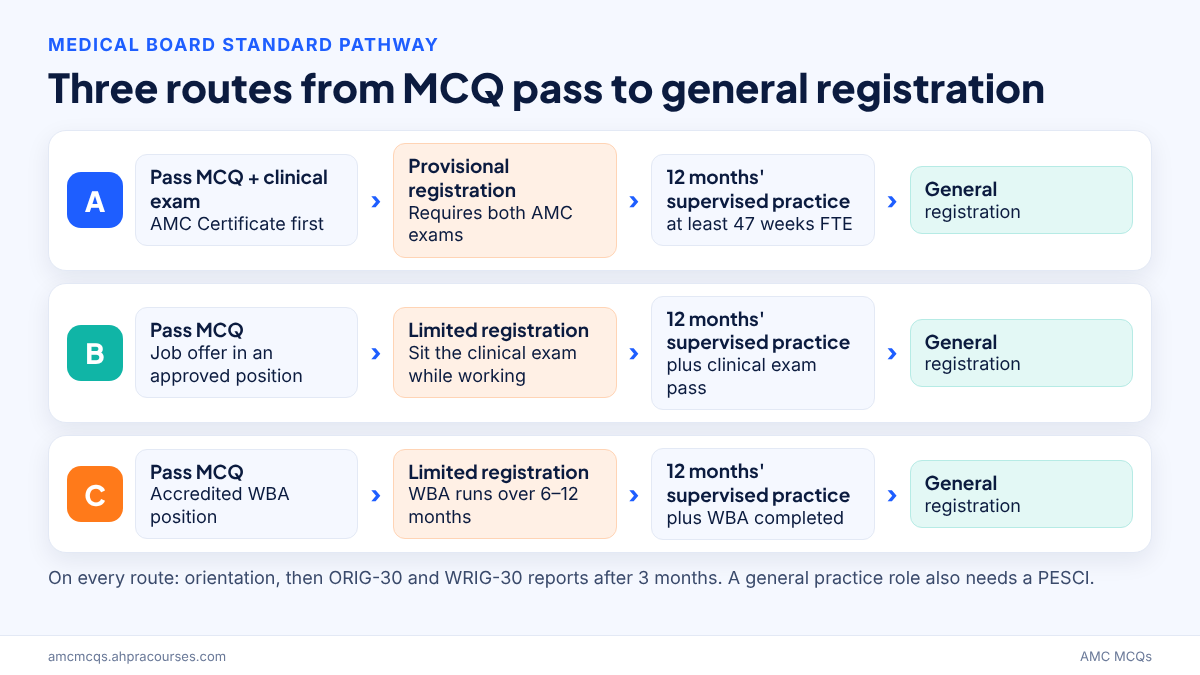
The Medical Board's standard pathway page sets out three routes from an MCQ pass to general registration.
| Route | What you pass first | Registration while you work | Then |
|---|---|---|---|
| A. Both AMC exams first | MCQ and clinical exam (AMC Certificate) | Provisional | 12 months' supervised practice, then general |
| B. Clinical exam during practice | MCQ | Limited | Pass the clinical exam and complete 12 months' supervised practice, then general |
| C. WBA during practice | MCQ | Limited | Complete the WBA and 12 months' supervised practice, then general |
On every route, you complete an orientation to the Australian health system. After three months of practice, your supervisor submits an orientation report (ORIG-30) and a work performance report (WRIG-30).
Limited registration comes in four types:
- postgraduate training or supervised practice
- area of need
- public interest
- teaching or research.
All four let internationally qualified doctors practise under supervision.
Supervised practice: 12 months, at least 47 weeks FTE
The Board must approve both your position and your supervision arrangements. You will need:
- a nominated supervisor
- a supervised practice plan (SPPA-30) that your supervisor agrees to
- a declaration (DFLP-00) completed by your supervisor.
The Board's supervision guidelines define four levels of supervision.
| Level | Who holds responsibility | Supervisor presence |
|---|---|---|
| 1 | Supervisor takes direct and principal responsibility for each patient | On site whenever you see patients; every patient discussed before they leave |
| 2 | Shared, with autonomy based on your assessed competence | Primarily in person, on site at least 80% of the time; daily case reports |
| 3 | You take primary responsibility | You may work alone if the supervisor can be reached by phone or video |
| 4 | You take full responsibility | Oversight and periodic review |
Doctors on Level 1 or 2 supervision cannot be approved for positions that consist only of on-call or home visits, and cannot work as locums.
General practice positions and the PESCI
If you apply for provisional or limited registration to work in general practice, you will usually need a pre-employment structured clinical interview (PESCI) for that specific position. It is run by an AMC-accredited provider: ACRRM, METC Institute or the RACGP. At least three interviewers assess whether you suit the role and what supervision you need. Limited registration for an area-of-need general practice role also requires at least three years' full-time-equivalent general practice or primary care experience before the PESCI.
Timing your application
- Apply at least three months before your intended start date.
- The Board accepts applications up to six months early, and your start date can be moved back by up to 90 days.
- Once registered, you must join an AMC-accredited CPD home and complete 50 hours of CPD each calendar year.
- To move to general registration, you show the expected learning outcomes using the Board's evidence guidance for AMC Certificate holders.
English language requirements
English proficiency is a Medical Board requirement, not an AMC one. The AMC advises getting your proof of English before you apply under any AMC pathway. You can meet the standard through education in a recognised country (such as the UK, Ireland, the US, Canada or New Zealand), through advanced education, or by sitting an approved test. For doctors, the Board also accepts NZREX or PLAB.
| Test (taken on or after 23 April 2026) | Overall | Listening | Reading | Writing | Speaking |
|---|---|---|---|---|---|
| IELTS Academic | 7 | 7 | 7 | 6.5 | 7 |
| OET | N/A | 350 | 360 | 350 | 360 |
| PTE Academic | 63 | 58 | 59 | 60 | 76 |
| TOEFL iBT | 91 | 22 | 22 | 23 | 24 |
- Results must be from within the two years before you lodge your application.
- You can use one sitting, or two sittings no more than 12 months apart, but you can't combine results from different test providers.
- With two sittings, you must meet the overall score in each one, and no component can fall below the floor. For IELTS the floor is 6.5.
- Tests taken on or before 22 April 2026 are judged against the older scores in Ahpra's transition policy.
Jobs, visas and Medicare: what the official sources say
This is the part of the pathway with the most second-hand advice, so stick to these verified points.
- Visa timing: the Medical Board advises applying for your visa only after Ahpra has granted registration, and including your registration number. The AMC issues a placement letter for your MCQ booking, which can help if you need a visa to travel for the exam. Check visa options with the Department of Home Affairs, not agents' summaries.
- Medicare restrictions (section 19AB): the 10-year moratorium applies to overseas-trained doctors and foreign graduates of accredited medical schools. It runs from your first medical registration in Australia. To provide Medicare-rebateable services during that time, you generally need to work in a Distribution Priority Area or another eligible location.
- Scaling: working in more remote areas shortens the moratorium. It is not reduced in major cities (RA1), and drops to 9 years in inner regional areas (RA2), 7 years in outer regional areas (RA3), 6 years in remote areas (RA4) and 5 years in very remote areas (RA5). Scaling has conditions, including a monthly Medicare billing threshold of A$5,000.
- Finding a job: employers offer positions, not the AMC or the Board. State health department IMG recruitment pages and the accredited WBA sites are official places to start, and general practice roles also need a PESCI.
AMC standard pathway costs and timeline
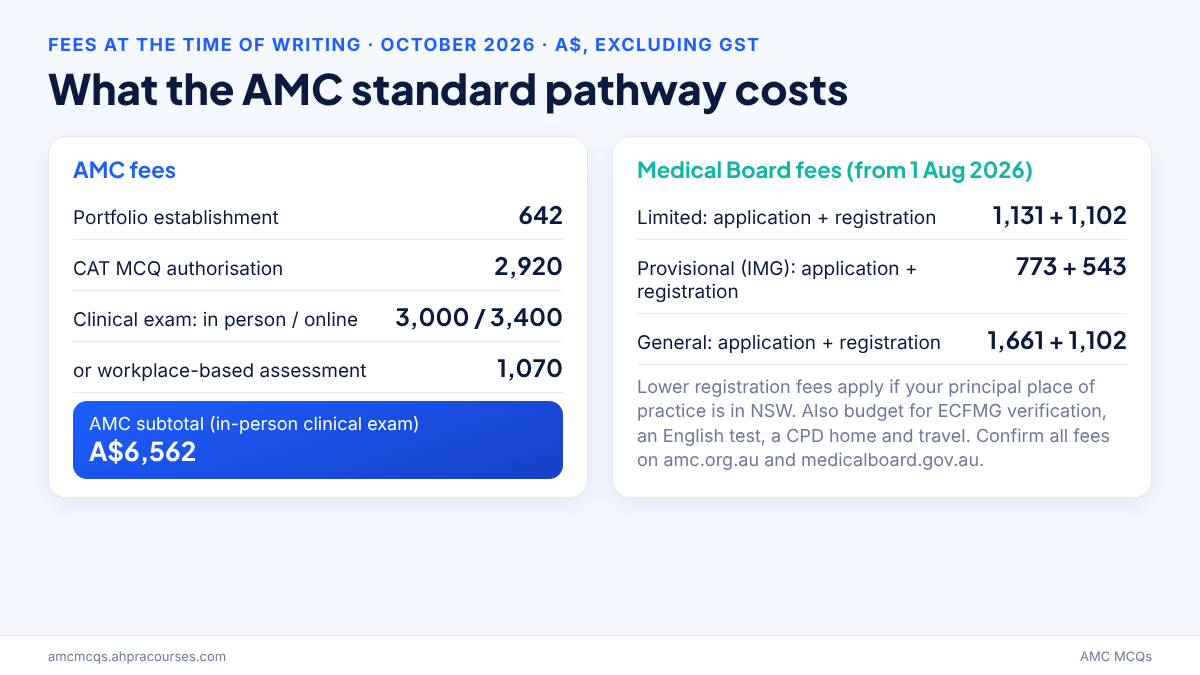
At the time of writing, these are the main published fees. Medical Board fees took effect on 1 August 2026. If your principal place of practice is in NSW, you pay lower annual registration fees: A$925 for general and limited registration, and A$477 for provisional (application fees are the same).
| Item | Fee (A$) | Paid to |
|---|---|---|
| Portfolio establishment (including one qualification) | 642 | AMC |
| CAT MCQ examination authorisation | 2,920 | AMC |
| Clinical examination: in person / online | 3,000 / 3,400 | AMC |
| Workplace-based assessment (instead of the clinical exam) | 1,070 | AMC |
| Limited registration: application + annual registration | 1,131 + 1,102 | Medical Board / Ahpra |
| Provisional registration (IMG): application + annual registration | 773 + 543 | Medical Board / Ahpra |
| General registration: application + annual registration | 1,661 + 1,102 | Medical Board / Ahpra |
The AMC fees alone come to A$6,562 if you sit the clinical exam in person, A$6,962 if you sit it online, or A$4,632 if you take the WBA route. All AMC fees exclude GST. On top of that, budget for:
- ECFMG verification
- an English test
- a CPD home membership
- travel to the exam.
Each new attempt needs a new authorisation and the full fee, which is the strongest financial argument for passing first time.
The fixed time points are:
- results three weeks after each exam
- the AMC Certificate within about 5 business days of results
- a WBA over 6 to 12 months
- at least 12 months of supervised practice.
How long you wait for an exam seat, a job offer and visa processing depends on availability, so plan in stages rather than to a single date.
How the MCQ fits into everything after it
The MCQ is more than a gate. The clinical exam stations draw on the same knowledge: the Australian guidelines, the screening programs, the medicolegal rules and safe prescribing. A WBA then tests that knowledge in real patients every week. Doctors who prepared properly for the MCQ usually find their clinical preparation is about communication and structure, not relearning medicine.
- Build your knowledge base with our AMC MCQ study plan and the high yield topics.
- Learn the Australian specifics in Australian guidelines for the AMC MCQ. Master consent, confidentiality and mandatory reporting in our guide to AMC ethics questions, because these come up again in counselling stations.
- Check what each AMC step costs in AMC MCQ fees and booking, and use the tactics in how to pass the AMC MCQ first attempt.
Sit a timed AMC MCQ mock exam
Blueprint-weighted questions under exam timing, then a breakdown of your result by domain.
Frequently asked questions
What comes after the AMC MCQ on the standard pathway?
You either sit the AMC Clinical Examination or complete an accredited workplace-based assessment. Once you pass, you receive the AMC Certificate. You also complete 12 months of supervised practice on provisional or limited registration before applying for general registration.
Can I work in Australia after passing only the AMC MCQ?
Yes, potentially, on limited registration. You need a job offer for a Board-approved supervised position and must meet the English and other registration requirements. You would then sit the clinical exam or complete a WBA while working.
How many stations do I need to pass in the AMC Clinical Examination?
You need to pass 9 or more of the 14 scored stations. The exam has 16 assessed stations, two of which are usually unscored pilot stations, plus four rest stations.
Is WBA easier than the AMC clinical exam?
Neither is easier. A WBA assesses you over 6 to 12 months in your actual job, so it suits doctors already employed at an accredited site. You can only start it after registration, and places are limited. The clinical exam can be sat before or after registration.
How long is supervised practice for general registration?
Twelve months, including at least 47 weeks of full-time-equivalent practice, in a position and under supervision arrangements the Board has approved.
What IELTS score do I need for Medical Board registration?
For tests taken on or after 23 April 2026, you need 7 overall in IELTS Academic, with 7 in listening, reading and speaking and 6.5 in writing. Results must be less than two years old when you apply.